sandbox-probe: Putting AI sandboxing to the test
The use of AI Agents to empower developer output and performance is growing, but many still rightly worry it may autonomously go rogue.
Misalignment and hallucinations pose several doubts when adopting these kinds of tools, as research at OpenAI and Anthropic has shown. Less than one month ago there was the high profile case of an OpenClaw agent nuking the inbox of Summer Yue, Meta Superinteligence’s Safety and Alignment.
Not only are intrinsic risks in LLMs a source of issues, but there are also
cases of malicious AGENTS.md files influencing tools like
Cursor and Copilot to take action that
was malicious without user consent.
For these agents to be useful, they generally need some power to act upon resources. With all this delegated, human power, it’s important to have guardrails. Many agent tools have built-in sandboxing measures to enforce some basic “sensible” rules.
Announcing the Sandbox Probe

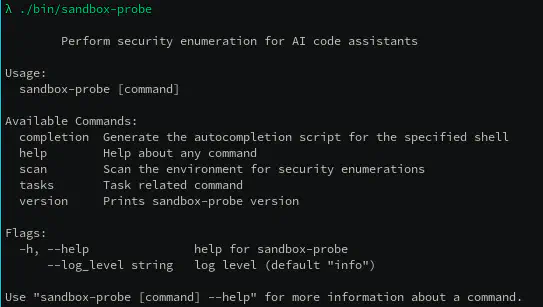
Sandbox Probe is ControlPlane’s research project to test the boundaries of generative AI Agents and other sandboxes.
The tool can be executed within any sandbox, and produces a detailed report on access to resources across your machine. This information allows end users to make informed decisions on security lock-down, and detect potential vulnerabilities in sandboxing.
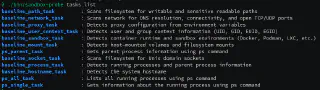
sandbox-probe runs through a series of tasks to identify
the outer boundaries of whatever sandbox it’s running in.
Industry Analysis
We’re running sandbox-probe to monitor the ongoing changes across the agentic
security landscape. See the changelog reports here.
Running the Tool
Executing sandbox-probe run invokes the tasks in order. With a pure sandbox
like nono, or running your own container, you can execute it manually.
For a tool like an Agent CLI, you’ll want to ask the agent to execute that command, and (hopefully) it’ll ask for your permission to run the program.
By default, it outputs the probe report to the CLI and also tries to write it to
report.json. This ensures you can see the report, even if the sandbox doesn’t
permit writing files. The threat model of the agent intercepting stdout and
rewriting output is not currently supported.
You can pick and choose which tasks to run by providing --tasksets e.g.
--tasksets baseline,ps. For example: if
a sandbox is very permissive, and you have many files on the filesystem,
skip over the baseline_socket_task that has to crawl the filesystem looking
for Unix Sockets.
Alternatively you can use the --fast flag to skip over some directories that
probably wouldn’t have anything interesting in them, but would take a long
time to process. E.g. node_modules or anything under what should be your
protected /nix mount. As mentioned this could compromise your report and
miss sockets hiding in those locations, but it’s very useful for quick test
runs.
Output
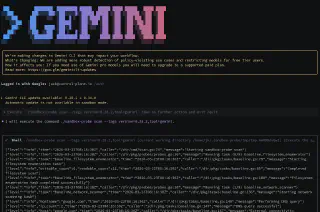
Here’s an example of running sandbox-probe via gemini with its
container based sandboxing enabled.
Next Steps
We’ll continue to expand the test infrastructure in the changelog reports, and add further probes as features are added to sandboxes.
Deploying AI into production? Check out our AI Security services, from prompt firewall tuning and Red Teaming to agentic identity and GitOps.
Related blogs

Out on the GenAI Wild West: Part II - The Long Arm of the Law
Check Point and ControlPlane Partner to Help Enterprises Securely Scale AI and Accelerate Agentic Innovation